
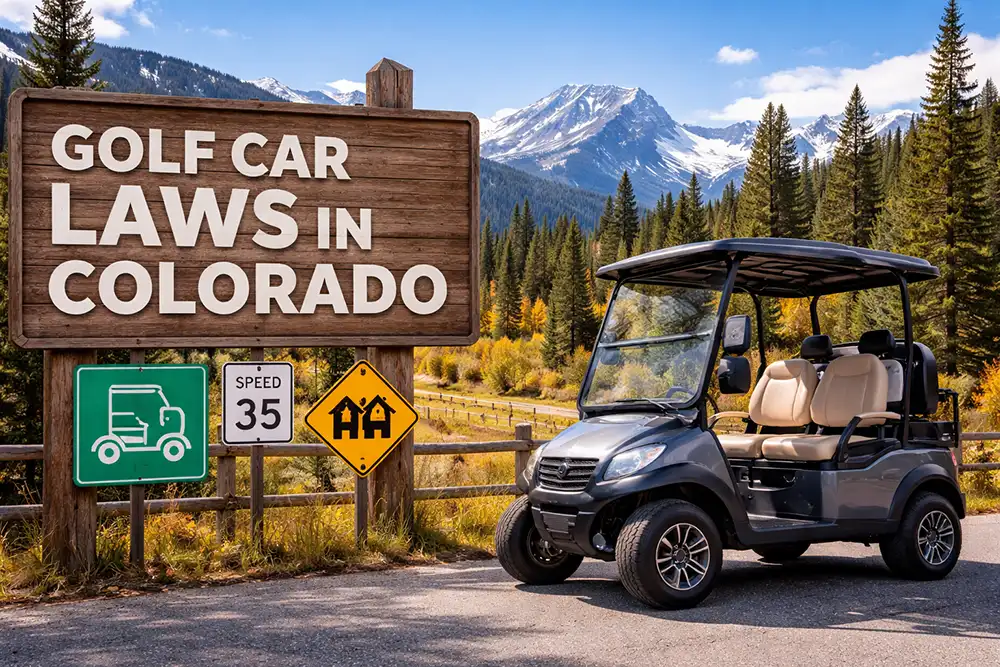
If you’ve ever tried to look up golf car laws in Colorado, you already know how this usually goes. You search online, skim a few articles, maybe read part of a state statute, and somehow walk away more confused than when you started.
Totally normal.
Colorado doesn’t treat golf cars the same way Florida or Arizona does. There’s no single rule that covers everything. Instead, it’s a mix of state law, vehicle classification, and local city or county rules. That’s why one neighborhood allows carts everywhere and another down the road doesn’t.
So let’s break this down in plain language.
First, Colorado Doesn’t Really Love the Term “Golf Cart”
This is where most confusion starts.
In Colorado law, a basic golf cart is generally seen as an off-road vehicle. That means if it’s truly just a golf cart with no safety equipment, it’s usually limited to private property or golf courses.
Once you start adding safety equipment and registering it properly, the vehicle often falls into a different category entirely. That’s where street legal golf carts and LSVs come into play.
If you want a simple explanation of how carts become street legal and what separates them from basic golf carts, this page explains it clearly
👉 street legal golf carts
What Colorado Really Regulates Is Speed and Safety
Colorado doesn’t care much about what you call the vehicle. What it cares about is
how fast it goes
what safety equipment it has
where it’s being driven
That’s why so many street-legal carts fall under the LSV category instead of being treated like golf carts at all.
If you’re unfamiliar with what qualifies as an LSV and why that matters, this guide is worth reading
👉 LSV
LSVs are designed to operate on roads with posted speed limits of 35 mph or less, assuming local laws allow them.
Where You Can Drive a Golf Car in Colorado Depends on the City
This is the big one.
Colorado gives cities and towns a lot of authority to decide whether golf cars or LSVs can operate on local roads. That means
some towns allow them freely
some allow them only in specific neighborhoods
some ban them outright
You might be perfectly legal in one community and ticketed in the next. There’s no statewide green light.
If you’re planning to use a cart beyond private property, always check your city code. Seriously. This one step saves a lot of headaches.
Equipment Matters More Than People Realize
Colorado law places a lot of emphasis on safety equipment. If your vehicle is registered as an LSV, it typically needs things like
seat belts
headlights and brake lights
turn signals
mirrors
windshield
VIN number
Without these, your cart is usually treated as an off-road vehicle, even if it looks fancy.
This is why many people think their cart is legal until they actually get stopped.
Registration, Insurance, and Plates Are Often Required
Another surprise for a lot of owners.
If your cart qualifies as an LSV in Colorado, it usually needs
registration
license plates
insurance
At that point, it’s treated more like a small car than a golf cart. This also means the driver typically needs a valid driver’s license.
Again, this can vary slightly by jurisdiction, but skipping this step is one of the most common mistakes.
Neighborhoods and HOAs Can Override Everything
Even if your city allows golf cars or LSVs, your HOA might not.
HOAs in Colorado often have their own rules about
vehicle types
parking
road use
So yes, you can technically be legal under state law and still not allowed to drive your cart in your own neighborhood. It’s annoying, but it happens all the time.
Winter Is a Whole Different Conversation
Colorado weather matters.
Snow, ice, and steep grades can change how local law enforcement views golf car use. Some cities that allow carts in summer quietly discourage them in winter months for safety reasons.
Even if not written into law, enforcement can get stricter during bad weather.
FAQs About Golf Car Laws in Colorado
In most cases, not unless it meets LSV requirements and local laws allow it. A basic golf cart without safety equipment is usually restricted to private property or golf courses. Some towns allow limited use, but that’s the exception, not the rule.
Generally, roads with posted speed limits of 35 mph or less, assuming the local municipality allows LSVs. Even then, certain roads may be restricted due to traffic flow or safety concerns.
If the vehicle is registered as an LSV, yes, a valid driver’s license is typically required. For basic golf carts on private property, licensing rules usually don’t apply.
If it’s classified as an LSV and registered for street use, insurance is usually required, just like any other motor vehicle. Basic golf carts used off-road generally do not require insurance.
This depends heavily on classification and local law. On private property, owners often allow it, but once a cart is street legal and registered as an LSV, underage drivers are typically not allowed.
Some mountain towns allow LSVs in limited areas, but terrain, weather, and road design often restrict use. Steep grades and narrow roads make enforcement stricter in these areas.
A golf cart is generally considered an off-road vehicle. An LSV meets specific federal and state safety requirements and is treated more like a passenger vehicle for registration and road use.
Yes. Colorado allows local governments to set their own rules. A city can restrict or prohibit golf carts and LSVs on its roads regardless of state allowances.
Final Thoughts
Colorado isn’t anti-golf cart. It’s just cautious.
The state focuses on safety, road compatibility, and local control. If you understand how vehicles are classified and take the time to check local rules, owning and using a cart here can be straightforward.
If you skip that homework, it can get expensive fast.
Disclaimer
This article is for general informational purposes only. Golf car and LSV laws can vary by city, county, HOA, and may change over time. Always research and confirm regulations within your specific community prior to operating any golf car or LSV on public or private roads.