
Quick Answer: Registering an LSV in Colorado requires a completed title application, a bill of sale or manufacturer’s certificate of origin (MCO), proof of insurance, a valid Colorado driver’s license, and payment of applicable registration and ownership tax fees. The process is handled through your local county motor vehicle office, not online. Your LSV must meet federal FMVSS 500 standards and be equipped with all street-legal safety equipment before registration can be completed. Once registered, Colorado LSVs receive standard vehicle license plates and are legally permitted on roads posted at 35 mph or under.
Buying a Sierra LSV is the easy part. Getting it properly registered in Colorado is where most buyers hit a wall — not because it’s complicated, but because the process isn’t well-explained anywhere. This guide walks you through exactly what you need, where to go, and what to expect.
Disclaimer: Registration requirements and fees can change. Always confirm current requirements with your local Colorado county motor vehicle office before submitting paperwork.
Step 1: Confirm Your LSV Meets Federal FMVSS 500 Standards
Before you can register your LSV in Colorado, it must meet the federal FMVSS 500 standard for low-speed vehicles. This means the vehicle must have a maximum speed between 20 and 25 mph and be equipped with:
- Headlights, taillights, and brake lights
- Turn signals and reflectors
- Seatbelts for all seating positions
- Rearview mirrors
- Windshield
- Parking brake
- A federally assigned VIN
All Sierra LSVs sold through Daytrip Carts come fully street-legal and FMVSS 500 compliant. If you’re unsure whether your vehicle qualifies, check the manufacturer documentation or contact your dealer. For a full overview of what makes a vehicle legally an LSV in Colorado, see our Colorado LSV laws guide.
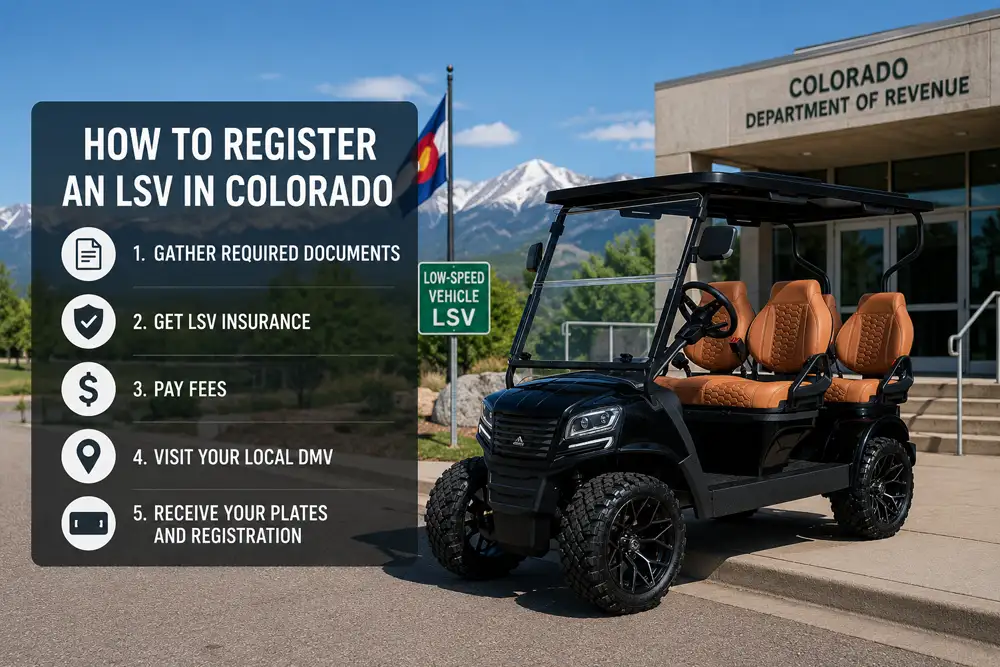
Step 2: Gather Your Documents
You’ll need the following to register your LSV at the county motor vehicle office:
Manufacturer’s Certificate of Origin (MCO) or Title New vehicles come with an MCO from the manufacturer. If you’re buying used, you’ll need the current title signed over to you by the seller.
Bill of Sale A signed bill of sale documenting the purchase price, date, buyer, and seller. Daytrip Carts provides this with every purchase.
Proof of Insurance Colorado requires liability insurance on all registered road vehicles, including LSVs. You’ll need a current insurance card or declaration page showing your name and the vehicle’s VIN. Contact your auto insurance provider — most standard carriers can add an LSV to an existing policy.
Valid Colorado Driver’s License The registered owner must hold a valid Colorado driver’s license or state-issued ID.
Completed Title Application (DR 2395) This form is available at your county motor vehicle office or online through the Colorado DMV. It captures vehicle information, purchase price, and owner details.
Emissions Exemption Electric LSVs are exempt from Colorado emissions testing. No testing certificate is required.
Step 3: Calculate What You’ll Owe
Registration costs in Colorado are based on the vehicle’s purchase price, weight, and age. You’ll typically pay:
Ownership Tax (also called Specific Ownership Tax or SOT): Calculated as a percentage of the vehicle’s purchase price. Expect roughly 2–4% of the purchase price in the first year, declining with vehicle age.
Registration Fees: These include a base registration fee, a road safety surcharge, and county fees. Total fees typically run $50–$150 for an LSV depending on your county.
Title Fee: Usually $7.20 for a standard title.
Contact your county motor vehicle office for exact current fee schedules before you visit.
Step 4: Visit Your County Motor Vehicle Office
LSV registration in Colorado is handled in person at your local county motor vehicle office — not online. Bring all documents from Step 2 and be prepared to pay fees in full at the time of registration.
Counties with Daytrip Carts customers frequently process LSVs at the following offices, though any county office can handle the registration:
- Denver: Denver Motor Vehicle — multiple locations; check current hours before visiting
- Boulder: Boulder County Clerk and Recorder
- Douglas County: Douglas County Motor Vehicle
- Jefferson County: Jefferson County Motor Vehicle
Bring everything organized. The process typically takes 30–60 minutes on your first visit.
Step 5: Receive Your Plates and Registration Documents
Once processed, your LSV will receive standard Colorado license plates (not specialty golf cart permits). You’ll also receive a registration document to keep in the vehicle — Colorado law requires it to be available for inspection during any traffic stop.
After registration, your LSV is legally permitted on any Colorado road posted at 35 mph or under. You may also cross roads with higher speed limits at intersections where it’s safe to do so. Review our Colorado LSV laws overview for a full rundown on where you can and can’t drive.
What About Insurance?
Colorado requires liability insurance on all registered vehicles, and LSVs are no exception. Most major auto insurers — including State Farm, GEICO, Progressive, and Nationwide — offer coverage for LSVs. Call your existing provider and ask to add your LSV as an additional vehicle. Rates are typically much lower than standard automobile insurance given the vehicle’s limited speed and road access.
Some insurers classify LSVs as specialty vehicles and route coverage through golf cart or recreational vehicle policies. Make sure whatever policy you get explicitly covers use on public roads, not just private property.
Renewing Your Registration
Colorado LSV registration must be renewed annually. You’ll receive a renewal notice by mail approximately 60 days before expiration. Online renewal is available through the state’s myDMV portal once the vehicle is in the system.
Do I Need to Smog Test My Sierra LSV?
No. Electric vehicles are fully exempt from Colorado emissions inspections. This includes all Sierra LSVs, which are 100% electric.
LSV Registration vs. Golf Cart — What’s the Difference?
A standard golf cart cannot be registered as a road vehicle in Colorado because it doesn’t meet FMVSS 500 standards. You can read more about the difference between LSVs and golf carts in our comparison guide. The short version: if your vehicle isn’t FMVSS 500 compliant from the factory, registering it as an LSV isn’t possible without significant modification.
Frequently Asked Questions
Can I register a golf cart as an LSV in Colorado?
Only if the golf cart meets all FMVSS 500 requirements — including seatbelts, DOT-compliant lighting, mirrors, windshield, and a federally assigned VIN. Most standard golf carts do not qualify without substantial modification.
Do I need a driver’s license to register an LSV in Colorado?
Yes. The registering owner must hold a valid driver’s license or state-issued ID. You also need a valid license to legally operate the LSV on public roads.
Can I register my LSV online in Colorado?
Initial registration must be done in person at your county motor vehicle office. Annual renewals can be completed online through the Colorado myDMV portal once the vehicle is in the system.
How much does it cost to register an LSV in Colorado?
Total first-year costs typically run $100–$300 depending on purchase price and county fees. This includes the specific ownership tax, registration fees, and title fee. Contact your county motor vehicle office for exact current amounts.
Do I need a special license plate for an LSV in Colorado?
No. Colorado LSVs receive standard vehicle license plates, not specialty permits or golf cart stickers.
How long does LSV registration take in Colorado?
Expect 30–60 minutes at the county motor vehicle office for initial registration. Processing is typically same-day.