
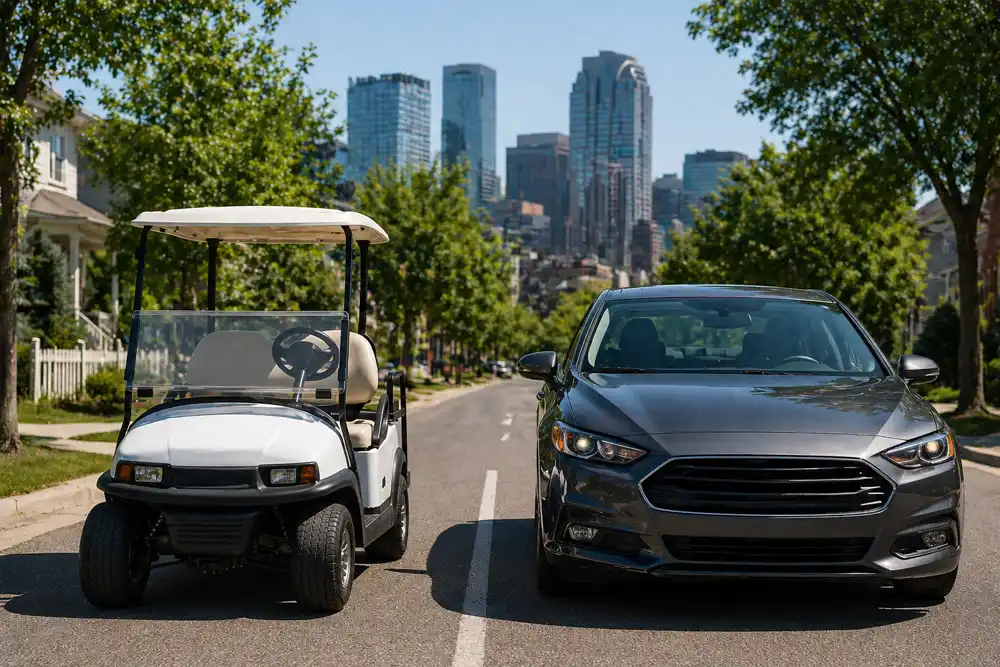
Deciding between a golf cart vs car for your daily commute? There’s a reason you’re seeing more golf carts on the road in Colorado. What used to be something you only saw on a course is now showing up in neighborhoods, downtown areas, and even daily commutes. The idea sounds appealing on the surface. Lower cost. Easier driving. Electric power. But once you move past the surface, the real question becomes more practical.
Is a golf cart actually worth it compared to owning a car?
The answer depends on how you live, where you drive, and what you expect from your vehicle. This isn’t just a lifestyle choice. It’s a financial decision, a convenience decision, and in some cases, a legal one. Let’s break it down in a way that actually reflects real ownership, not just marketing claims.
Upfront Cost: Golf Cart vs Car
The first thing most buyers look at is the purchase price, and this is where golf carts immediately stand out.
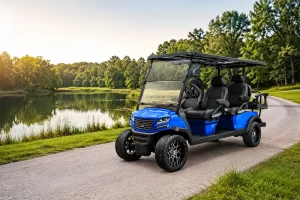
A street legal golf cart typically ranges from about eight thousand dollars on the low end to fifteen thousand or more for higher end models with lithium batteries, upgraded seating, and tech features. That price range puts it well below most new vehicles and even under many used cars that are only a few years old.
Now compare that to a typical car. A reliable used car in today’s market can easily land between twenty thousand and thirty thousand dollars. A new car often pushes beyond forty thousand without much effort.
That gap is what pulls people in.
But upfront cost alone doesn’t tell the full story. A golf cart is not a full replacement for a car in every situation, and that matters when evaluating value.
If your goal is to completely replace your vehicle, you have to consider whether a golf cart can realistically cover all of your daily needs. For some people in Colorado, especially those in golf cart friendly areas, the answer is yes. For others, it becomes more of a secondary vehicle.
Daily Use and Practicality
This is where the comparison gets more nuanced.
A car is built for everything. Highway driving, long distance travel, weather conditions, cargo, passengers, and speed. It’s designed to handle unpredictable situations without much thought.
A golf cart is different. It’s designed for shorter distances, lower speeds, and local travel. Most street legal models are limited to around twenty five miles per hour and are best suited for roads with lower speed limits.
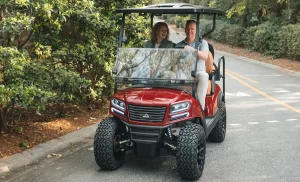
In many Colorado communities, especially around Denver and surrounding areas, this works surprisingly well. Running errands, picking up food, driving to local shops, and even short commutes can all be done in a golf cart.
But once you step outside of that local bubble, limitations show up quickly. You’re not taking a golf cart on the highway. You’re not driving it across the state. And while modern models are comfortable, they are not designed for long road trips.
So the real question becomes this. Are most of your daily trips local?
If the answer is yes, a golf cart becomes far more practical than most people expect.
Operating Costs: Where Golf Carts Win Big
Once you get past the purchase price, the long term cost difference becomes even more noticeable.
A gas powered car requires constant fuel. Even with decent fuel efficiency, you are still spending hundreds or thousands per year depending on how much you drive.
A golf cart runs on electricity. Charging a golf cart costs a fraction of what you would spend on gas. For many owners, the monthly charging cost is barely noticeable.
Insurance is another major factor. Car insurance in Colorado continues to rise, especially for newer vehicles. Full coverage can easily run over one hundred dollars per month or more depending on the driver and vehicle.
Golf cart insurance is typically much lower. Some owners pay a fraction of what they would for a car, especially if the cart is used locally and driven less frequently.
Then there is registration and fees. A street legal golf cart does require registration in Colorado, but the cost is generally lower than a traditional vehicle.
Over time, these savings add up in a meaningful way. This is one of the strongest arguments in favor of golf cart ownership.
Maintenance and Repairs
Maintenance is where the gap between golf carts and cars becomes even more obvious.
A car has a complex engine, transmission, exhaust system, cooling system, and dozens of moving parts that require regular service. Oil changes, brake replacements, transmission service, and unexpected repairs are all part of ownership.
A golf cart, especially an electric one, is much simpler. There is no engine oil. Fewer moving parts. Less mechanical complexity overall.
That doesn’t mean zero maintenance, but it does mean less frequent and often less expensive service.
The main maintenance items for a golf cart include:
- Battery health and eventual replacement
- Tires and brakes
- Basic electrical components
Lithium battery systems, which are becoming more common, last longer and require less maintenance than older battery types. This makes ownership even easier over time.
When something does go wrong, repairs are usually more straightforward and less expensive compared to a car.
Weather and Comfort Considerations
Colorado weather is not always forgiving, and this is where cars still hold a clear advantage.
A car provides full protection from rain, snow, wind, and extreme temperatures. Heating and air conditioning are standard, and the enclosed cabin makes a big difference during winter months.
Golf carts can be equipped with enclosures, heaters, and other comfort upgrades, but they are not the same as a fully enclosed vehicle. Cold weather driving is possible, but it is not always ideal.
This becomes an important factor depending on how often you plan to drive and during what seasons.
For some owners, the golf cart becomes a primary vehicle in warmer months and a secondary option during winter. Others use it year round with the right setup, but it requires more tolerance for the elements.
Lifestyle Fit: Who Actually Benefits Most
Golf carts are not for everyone, but for the right person, they can make a lot of sense.
If you live in a neighborhood where everything you need is within a few miles, a golf cart can replace a large portion of your driving. If your daily routine consists of short trips, local errands, and nearby destinations, the convenience is hard to ignore.
They are also popular in communities that are already golf cart friendly, where local infrastructure supports low speed vehicles.
On the other hand, if your daily commute involves highways, long distances, or unpredictable travel, a golf cart will not fully replace a car.
This is why many buyers end up using a golf cart as a second vehicle rather than a complete replacement.
Pros and Cons of Choosing a Golf Cart Over a Car
The advantages are clear once you look at the full picture. Lower upfront cost, significantly reduced operating expenses, simpler maintenance, and a more relaxed driving experience all contribute to the appeal.
At the same time, the limitations are just as real. Speed restrictions, limited range compared to a car, weather exposure, and legal driving zones all need to be considered before making the decision.
The key is not to view this as a direct replacement in every scenario, but as a strategic alternative that fits certain lifestyles extremely well.
Final Verdict: Is It Worth It?
For the right buyer, a golf cart is absolutely worth it.
If your driving habits are local, your community supports street legal carts, and you are looking to reduce long term vehicle costs, the value becomes very clear. In many cases, owners find themselves using their golf cart far more than they expected.
If you rely heavily on long distance driving or need an all purpose vehicle for every situation, a golf cart alone will not replace a car.
The smartest approach for many people in Colorado is a hybrid one. Keep a car for long distance travel and use a golf cart for everything else. This combination often delivers the best balance of cost savings, convenience, and flexibility.
Golf Cart vs Car FAQs
Are golf carts cheaper than cars long term?
Yes, in most cases golf carts are significantly cheaper over time due to lower fuel costs, reduced maintenance, and cheaper insurance.
Can you legally drive a golf cart on the road in Colorado?
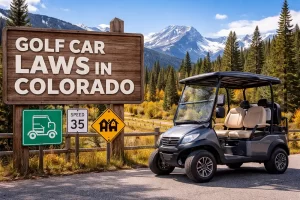
Yes, but only if it is classified as a street legal low speed vehicle and meets state requirements for lights, signals, and registration.
How far can a golf cart go on a full charge?
Most modern electric golf carts can travel between 30 and 60 miles depending on battery type and driving conditions.
Can a golf cart replace a car completely?
For some local drivers it can, but most people use it as a secondary vehicle due to speed and distance limitations.
Do golf carts require insurance in Colorado?
Yes, street legal golf carts typically require insurance similar to other registered vehicles.