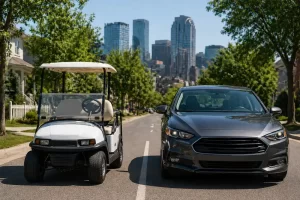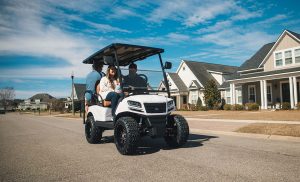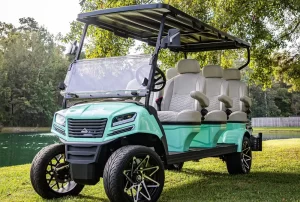

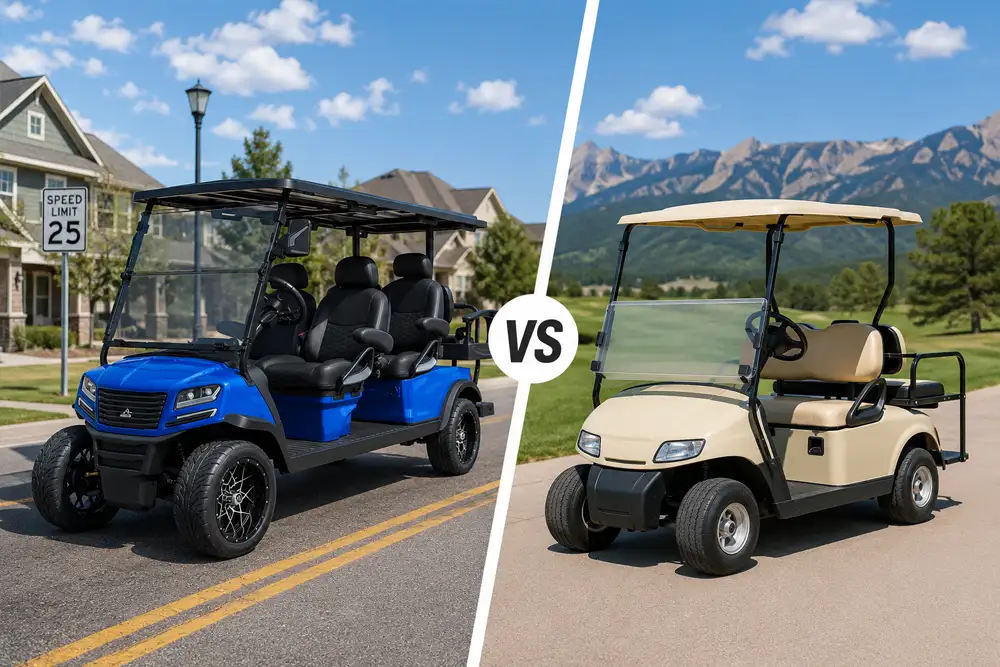
Quick Answer: An LSV (low-speed vehicle) is a federally regulated, street-legal vehicle capable of 20–25 mph, equipped with safety features including seatbelts, headlights, mirrors, turn signals, and a windshield. A golf cart is an unregulated utility vehicle designed for on-course or private property use, typically limited to 15 mph and not street legal without significant modification. In Colorado, LSVs can be driven on roads with speed limits of 35 mph or under with proper registration, insurance, and a driver’s license. Golf carts cannot legally operate on public roads unless modified to meet LSV standards.
If you’re shopping for a neighborhood vehicle, a resort cruiser, or a Colorado commuter for local roads, you’ve almost certainly run into both terms: LSV and golf cart. They look similar from a distance. They’re often marketed side by side. But they are fundamentally different vehicles — and choosing the wrong one can mean legal problems, safety issues, or a vehicle that simply doesn’t do what you need.
Here’s a straight comparison of the two, based on what actually matters when you’re deciding where to put your money.
What Is a Golf Cart?
A golf cart is a small, low-speed utility vehicle originally designed for use on golf courses. Standard golf carts travel 10–15 mph and are built for private property or closed courses — not public roads. They typically lack the safety features required for street use: no seatbelts, no DOT-compliant lighting, no mirrors, no windshield in many cases, and no horn.
Golf carts are not federally regulated as road vehicles. They’re utility machines — useful for campgrounds, farms, resorts, and large private properties where road access isn’t required.
What Is an LSV?
An LSV, or low-speed vehicle, is a federally recognized vehicle class regulated under FMVSS 500. To qualify, a vehicle must have a maximum speed between 20 and 25 mph and be equipped with:
- Headlights, taillights, and brake lights
- Turn signals and reflectors
- Seatbelts for every occupant
- Mirrors (front and rear)
- Windshield
- Parking brake
- VIN number
LSVs are street-legal on roads posted 35 mph or under in Colorado, provided the owner has registered the vehicle, holds a valid driver’s license, and carries insurance. They are treated more like a car than a cart when it comes to the law.
The 7 Differences That Actually Matter
1. Street Legality
This is the biggest one. A properly equipped Sierra LSV for sale can be legally driven on Colorado public roads posted at 35 mph or under. A standard golf cart cannot — period. Driving an unregistered golf cart on a public road in Colorado is a traffic violation, regardless of how close your house is to the road.
2. Speed
Golf carts cap out around 10–15 mph. LSVs are designed to operate at 20–25 mph — fast enough to keep up with neighborhood traffic and not become a road hazard. Sierra LSVs specifically offer 25 mph top speed with a selectable 15 mph low-speed mode for areas where lower speeds are required.
3. Safety Equipment
LSVs are required by federal law to include all the safety equipment listed above. Golf carts have none of these requirements. If you’re sharing a road with cars, trucks, and cyclists, that equipment gap matters.
4. Registration and Insurance
LSVs require DMV registration, a title, and liability insurance because it’s just like a car. Golf carts do not require any of this for private use, but also cannot access public roads because of it. For buyers planning to use their vehicle anywhere beyond their own property, LSV registration is non-negotiable. See our full guide on how to register an LSV in Colorado for step-by-step instructions.
5. Battery and Range
Modern LSVs like the Sierra lineup use lithium LiFePO4 batteries that deliver consistent performance and 30–50 miles of range per charge. Most golf carts still use lead-acid batteries with shorter range, inconsistent performance as charge depletes, and significantly higher long-term maintenance costs. The difference in real-world driving experience is noticeable.
6. Technology and Comfort
Today’s LSVs are a long way from the basic golf carts people picture. The Sierra AX3 includes a 9-inch LCD display, Apple CarPlay and Android Auto, a backup camera, wireless phone charging, RGB headlights, and hydraulic disc brakes on all four wheels. Golf carts typically offer basic instrumentation at best.
7. Cost
Golf carts generally cost less upfront — especially used models. LSVs carry a higher price point that reflects their federal safety compliance, lithium battery technology, and street-legal equipment. That said, the total cost of ownership often favors LSVs when you factor in lower battery maintenance, longer lifespan, and the added utility of road access.
Which Should You Buy?
Choose a golf cart if: You need a vehicle exclusively for a golf course, private farm, or large gated property. You won’t be driving on public roads. Budget is the primary concern and road access is not needed.
Choose an LSV if: You want to use your vehicle on public streets in Colorado neighborhoods, resort towns, or suburban areas. You value safety features, modern technology, and street-legal compliance. You plan to register the vehicle and carry insurance like you would any other road vehicle.
For Colorado buyers, the Colorado LSV laws guide covers exactly what you need to stay compliant on public roads.
The Bottom Line
Golf carts and LSVs serve different purposes. If you want a street-legal vehicle for Colorado roads, an LSV isn’t just the better choice — it’s the legal one. If you’re comparing specific Sierra LSV models, check out our full model comparison to find the right fit.
Frequently Asked Questions
Can a golf cart be converted to an LSV?
Technically yes, but it requires adding all federally mandated safety equipment, getting a VIN assigned, and passing a state inspection. In most cases it’s cheaper and simpler to purchase an LSV that’s already street-legal from the factory.
Do you need a driver’s license to drive an LSV in Colorado?
Yes. In Colorado, operating an LSV on public roads requires a valid driver’s license, vehicle registration, and proof of insurance — the same basic requirements as any road vehicle.
Are LSVs the same as NEVs?
NEV stands for Neighborhood Electric Vehicle and is used interchangeably with LSV in many contexts. Both refer to federally compliant low-speed vehicles with a 20–25 mph maximum speed. All Sierra LSVs qualify as both NEVs and LSVs.
What’s the maximum speed of a street-legal LSV in Colorado?
LSVs are federally capped at 25 mph by definition. In Colorado, they may operate on roads posted at 35 mph or under and may cross higher-speed roads at designated intersections.
Can I drive an LSV on a bike path or trail in Colorado?
No. LSVs are road vehicles and are not permitted on bike paths, hiking trails, or pedestrian paths in Colorado. They must remain on public roadways where they are legally permitted.
How do Sierra LSVs compare to other LSV brands?
See our Sierra LSV vs. E-Z-GO comparison and Sierra LSV vs. Icon comparison for a detailed look at how Sierra stacks up.