
Summary: A golf cart becomes street legal in Colorado once it qualifies as a low speed vehicle, or LSV, under federal standard FMVSS 500. That means adding the required safety equipment, getting a VIN assigned, passing inspection, and registering the cart with the state. This guide walks through each step. It also covers cost, timing, and how conversion compares to simply buying a factory built LSV.
What “Street Legal” Actually Means in Colorado
A standard golf cart counts as an off road vehicle under Colorado law. That means it can only be driven on private property or a golf course. To legally drive on public roads, a cart has to be reclassified as a low speed vehicle. An LSV is a four wheeled, electric powered vehicle. It is built to a federal safety standard called FMVSS 500. Its top speed sits between 20 and 25 mph.
Once a cart meets this standard and gets registered, Colorado allows it on roads posted at 35 mph or under. For the full legal picture, including city specific rules, see our guide to Colorado LSV laws. Our breakdown of golf car laws in Colorado covers more local detail.
The Equipment a Golf Cart Needs
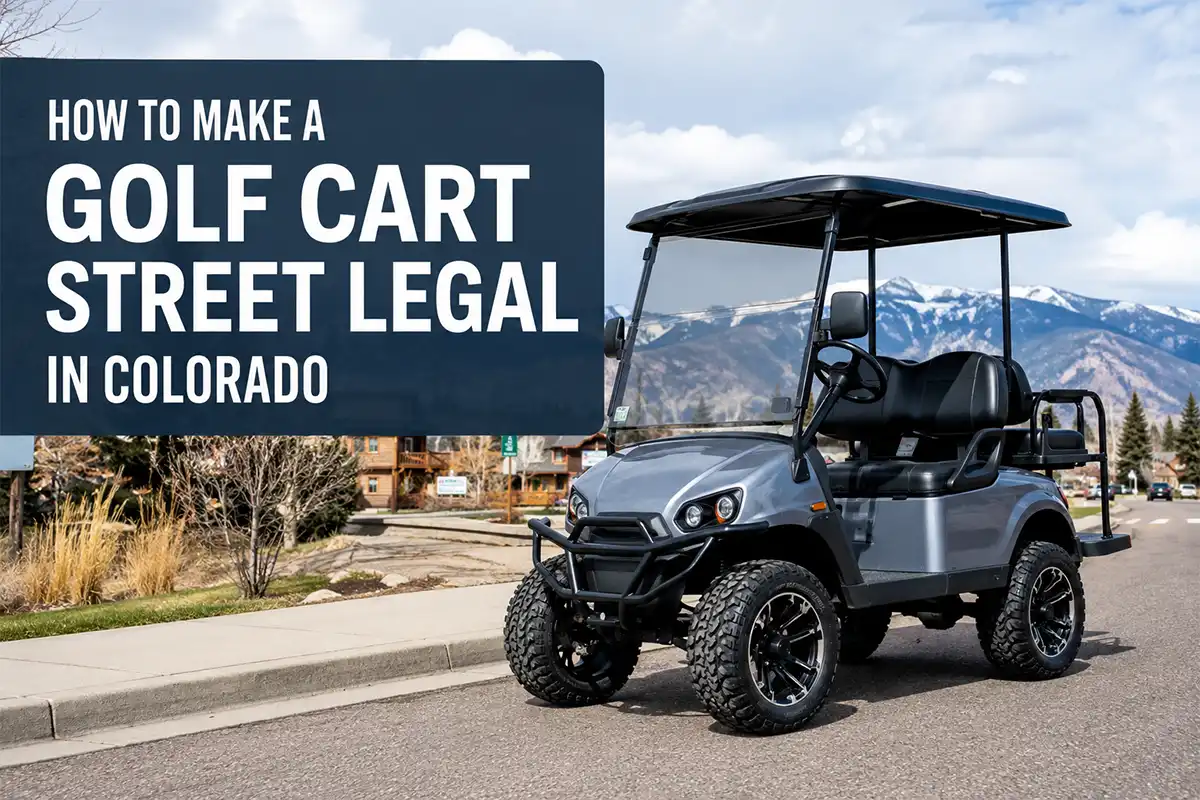
Before a cart can be registered as an LSV, it needs a specific list of safety features. These include seat belts for every seat, headlights, brake lights, and turn signals. The cart also needs mirrors, a windshield, and a horn. On top of that, it needs a vehicle identification number. A manufacturer assigns this VIN. An owner cannot simply add one later.
Without these features, a cart will not pass the inspection required for registration. This is true no matter how the cart looks or performs. This is also the step that trips up most do it yourself conversions.
Step by Step: Getting Your Cart Registered
Start by confirming your cart meets FMVSS 500 standards. If it does not, install the missing equipment first. Next, get a manufacturer’s certificate of origin. This document assigns the vehicle a VIN. From there, your cart needs a state safety inspection. This confirms it meets LSV requirements.
Once it passes inspection, you can register the cart at your county DMV. Bring the certificate of origin, proof of insurance, and a valid driver’s license. The DMV issues a title and license plate once everything checks out. From that point, your cart is legally a low speed vehicle.
How Much It Costs and How Long It Takes
Costs vary based on how much equipment your cart is missing. Adding seat belts, lighting, mirrors, and a windshield to an older cart can run into several thousand dollars once labor is included. That is before VIN assignment and inspection fees. A factory built LSV already includes all of this equipment. That means registration is usually a single trip to the DMV, not a multi week conversion project.
Comparing your options? Our team can walk you through current Sierra LSV pricing and what it includes. Browse factory built Sierra LSVs to see models that are already street ready.
Age and License Requirements
Colorado requires a valid driver’s license to operate an LSV on any public road. There is no separate age exception or limited permit for younger drivers. This is true even on quiet neighborhood streets. It applies the moment a cart is registered and driven outside private property. It does not matter how old the cart itself is or how it was converted.
Insurance is required as well. Once your cart is registered as an LSV, Colorado treats it like any other motor vehicle for liability purposes. Many drivers can simply add the LSV to an existing auto policy.
Convert Your Cart or Buy a Factory Built LSV
Converting an existing golf cart can work. It usually costs more time and money than buyers expect, once parts, labor, and inspection delays add up. Every Sierra LSV sold by Daytrip Carts already meets FMVSS 500 standards from the factory. There is no guessing about whether it will pass inspection. Want to compare specific models? Our Sierra AX model comparison breaks down seating, range, and pricing across the lineup. You can also explore custom LSV builds if you want street legal equipment paired with upgrades like lift kits or premium seating.
Where to Drive Once You’re Street Legal
Once your cart is registered, you can legally drive it on Colorado roads posted at 35 mph or under. Always check for local city or HOA rules first. Live in or near Longmont? Our local buyer’s guide covers good routes and neighborhood tips. Buyers further north can check our guide to golf carts near Fort Collins, Loveland, and Greeley. For ongoing ownership questions, our Sierra FAQ covers maintenance and warranty topics too.
Frequently Asked Questions
What equipment does a golf cart need to be street legal in Colorado?
A street legal golf cart needs seat belts, headlights, brake lights, turn signals, mirrors, a windshield, and a vehicle identification number, in line with federal standard FMVSS 500.
How much does it cost to make a golf cart street legal?
Converting an older golf cart can cost several thousand dollars once you add safety equipment, a VIN assignment, and inspection fees. Buying a factory built LSV often costs less in total once conversion labor is factored in.
How long does it take to register a golf cart as an LSV in Colorado?
Registering a factory built LSV usually takes a single visit to the county DMV with the right paperwork. Converting an existing golf cart takes longer, since it must pass inspection before it can be registered.
How old do you have to be to drive a golf cart on the road in Colorado?
Colorado requires a valid driver’s license to operate a low speed vehicle on public roads. There is no separate age based exception for LSVs beyond standard Colorado driver licensing rules.
Is it cheaper to convert a golf cart or buy a factory built LSV?
It is usually cheaper to buy a factory compliant LSV. Converting a golf cart requires adding safety equipment, assigning a VIN, and passing state inspection, which adds up in parts and labor.
Do I need insurance for a street legal golf cart in Colorado?
Yes. Once a golf cart is registered as an LSV, Colorado requires liability insurance, the same as any other registered motor vehicle.